
Children and Dogs: Building Safe, Happy Relationship
Updated: Apr 7
Building a Happy Home: Children and Dogs Together
Children and dogs can form wonderful bonds and learn a great deal from growing up together. To make that relationship safe and positive, clear rules and thoughtful management are essential. Dogs and children experience the world very differently, so adults need to set everyone up for success.
This guide explores the benefits, the common pitfalls, and the practical steps you can take to help children and dogs live together safely and happily.
The Benefits of Children and Dogs Living Together
When managed well, sharing a home can be hugely rewarding for both.
Dogs often benefit from:
Increased routine and structure
More exercise and mental stimulation
Appropriate, gentle affection
Companionship
Children benefit too! They learn empathy, gain confidence around animals, and enjoy the comfort and companionship that dogs bring to family life. Isn’t that a win-win?
Common Pitfalls in Homes With Children and Dogs
Despite the best intentions, challenges can crop up, particularly when expectations don’t match reality.
Common issues include:
Boisterous or unpredictable play
Loud or stressful moments such as tantrums
A lack of understanding of canine communication
Children grabbing, climbing on, or hitting dogs
Dogs snapping or biting when overwhelmed
Children are statistically at greater risk of dog bites than adults. Many bites occur to the head, neck, and hands. Most incidents are preventable with education, supervision, and thoughtful management.
Preparing for Your Puppy’s Arrival
Before Your Puppy Comes Home
Preparation is key, especially if your household already includes children. Creating clear dog-free and child-free areas gives everyone space to relax. A puppy pen works well as a child-free zone where your puppy can rest undisturbed.
Getting children involved by making posters showing the rules for the pen helps reinforce boundaries in a positive way. Using tape to mark areas around food and water bowls can also help younger children understand where not to go.
Before your puppy arrives, it’s helpful to practice safe handling using a stuffed toy. This allows children to learn how and where to stroke a dog without pressure. We recommend teaching children to stroke along the dog’s back and to avoid faces, ears, tails, and paws. A simple phrase we love is: “One hand is enough, two hands is too much.”
Setting clear household rules in advance sets children up for success once the puppy is home and avoids any confusion about what is and isn't allowed with the puppy.
Active Supervision Keeps Everyone Safe
Active supervision means watching both the child and the dog without distractions. If that isn’t possible, they should be separated. Most dog bites involving children happen when adults are distracted or not watching closely.
If you are cooking, on the phone, or otherwise occupied, pop your puppy in their pen or behind a stair gate.
You should intervene immediately if you notice:
A child approaching a dog who is sleeping or eating
Grabbing of ears, tails, or paws
A child following a dog that is trying to move away
A dog approaching a child who is holding food
Research published in the Journal of Veterinary Behaviour found that many parents struggle to recognize risky child–dog interactions, particularly with familiar dogs. Many admitted to leaving children and dogs unsupervised or turning their backs during interactions, highlighting how important proactive supervision really is.
Understanding the Ladder of Aggression
Dogs communicate primarily through body language, and bites rarely happen without warning. The Ladder of Aggression illustrates how dogs escalate their behaviour when early signals are ignored.
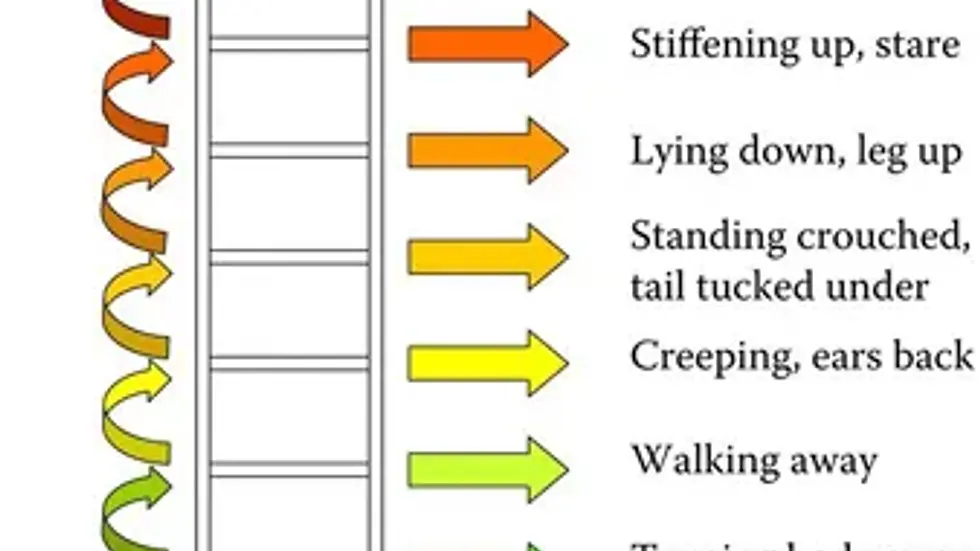
Early signs of stress can include:
Turning the head away
Lip licking or yawning
Blinking or freezing
Spotting these lower-level behaviours allows adults to step in early and give the dog space before behaviour escalates.
Games That Help Children and Dogs Bond Safely
Appropriate games allow children and dogs to interact positively while maintaining boundaries. They help build a bond without encouraging rough play or unsafe behaviour. All games should be supervised and chosen with your child’s age and ability in mind.
The Treat Tube
This is a simple, low-arousal game that keeps little fingers well away from sharp puppy teeth. To play, use a long cardboard tube, such as an empty wrapping paper tube. Have your child sit on a chair with the tube resting on their lap and the other end touching the floor. Your child can then drop small treats down the tube for the puppy to find on the floor. This encourages calm behaviour and prevents grabbing or hand-feeding.
Hide and Spoon
Hide and Spoon is a puppy-friendly version of hide and seek that combines recall practice with safe interaction. Give your child a wooden spoon with a small amount of something tasty on the end, such as yoghurt or peanut butter. While an adult holds the puppy, ask your child to go and hide nearby. Once hidden, they can call the puppy’s name. When the puppy finds them, your child lowers the spoon so the puppy can enjoy the treat without hands being involved.
Stand Like a Tree
Stand Like a Tree isn’t so much a game as a strategy, but it’s an important one for children to learn. Teach children that if a puppy jumps up or becomes too excited, they should stand still with their hands tucked into their armpits, look away, and call for help. This prevents squealing, running, or pushing the dog away, which can accidentally turn jumping and nipping into a fun game for the puppy.
Hand Touch
Hand Touch is a great trick for children to teach and practise, and it doubles as a simple recall. With an adult supervising, ask your child to hold out a flat hand. When the puppy touches their hand with their nose, the adult rewards the puppy with a treat. Over time, children can begin to cue the behaviour themselves. This encourages calm, focused interaction and gives children a safe, structured way to engage with their dog.
Simple Household Rules That Make a Big Difference
Clear, consistent rules help everyone understand their role.
Children should:
Leave dogs alone when they are eating, sleeping, or playing with toys
Call the dog over rather than approaching
Adults should:
Practise active supervision
Separate if supervision isn’t possible
Learn canine body language and intervene early
Model calm, respectful interactions
Training Support for Puppies in Family Homes
Training helps dogs learn calm behaviours around children and gives adults confidence in managing everyday situations.
You may find these options helpful:
Puppy classes for building strong foundations - https://www.goodalldogtraining.com/service-page/puppy-training-class?referral=service_list_widget
Puppy 1:1 training sessions for tailored family support - https://www.goodalldogtraining.com/service-page/1-2-1-puppy-training-sessions?referral=service_list_widget
Online puppy training for flexible learning around family life - https://www.goodalldogtraining.com/service-page/pre-puppy-training-consultation?referral=service_list_widget
Choosing Toys for Safe Play
I often recommend to clients with children that each child have their very own long, soft toy that they carry around so they can redirect puppy teeth away from them and onto something appropriate.
We love the Tugenuff toys as they are super enticing for puppies and fun for kids to choose their colour! Click on the link below to get 10% off:
Further Support
For additional child-friendly education around dogs and safety, visit kidsarounddogs.co.uk.
If you’d like help setting your puppy up for success in a family home, explore the training options above or get in touch for personalised support.
Remember, building a strong relationship between your child and your dog takes time and patience. But with the right approach, you can create a loving, safe environment for both. Happy training!


Comments